Claude Fable 5.2 Launches: 20% Cheaper, Faster, and Fewer Safety Blocks
Anthropic released Claude Fable 5.2 and Claude Mythos 5.2 on November 9. They are the same underlying model: Fable 5.2 adds cyber and biology safeguards and is open to paid Claude plans and the API, while Mythos 5.2 is limited to vetted organizations. API prices fall 20 percent to $8 and $40 per million input and output tokens, and outputs arrive up to 30 percent faster.
On this page
What Anthropic released on Monday
Anthropic announced Claude Fable 5.2 and Claude Mythos 5.2 on November 9, ten weeks after the 5.1 generation. The company is explicit that the two names describe one system: "Claude Fable and Claude Mythos are the same underlying model," with Fable carrying extra cybersecurity and biology safeguards so it can be offered to everyone.
 Anthropic's launch page, dated 9 November 2026. Screenshot: anthropic.com
Fable 5.2 is available to Pro, Max, Ultra, Team, and Enterprise subscribers, and to developers through the Claude Platform, Amazon Web Services, Google Cloud, and Microsoft's cloud under the model ID claude-fable-5-2. Paid subscribers get extra Fable usage during launch week, with one to three usage resets depending on how long they have subscribed. Mythos 5.2 stays application-only: organizations apply through Anthropic's Life Sciences and Cyber Verification Programs, and Enterprise customers can reach it inside Claude Security.
CNBC notes this is Anthropic's first frontier release since Dario Amodei called for a slower pace of AI development in September, and it lands as the company prepares a public listing that could come as soon as next week.
Pricing: a fifth cheaper, plus a fast mode
The API price drops to $8 per million input tokens and $40 per million output tokens, down from $10 and $50 for Fable 5.1, and Mythos 5.2 is priced the same.
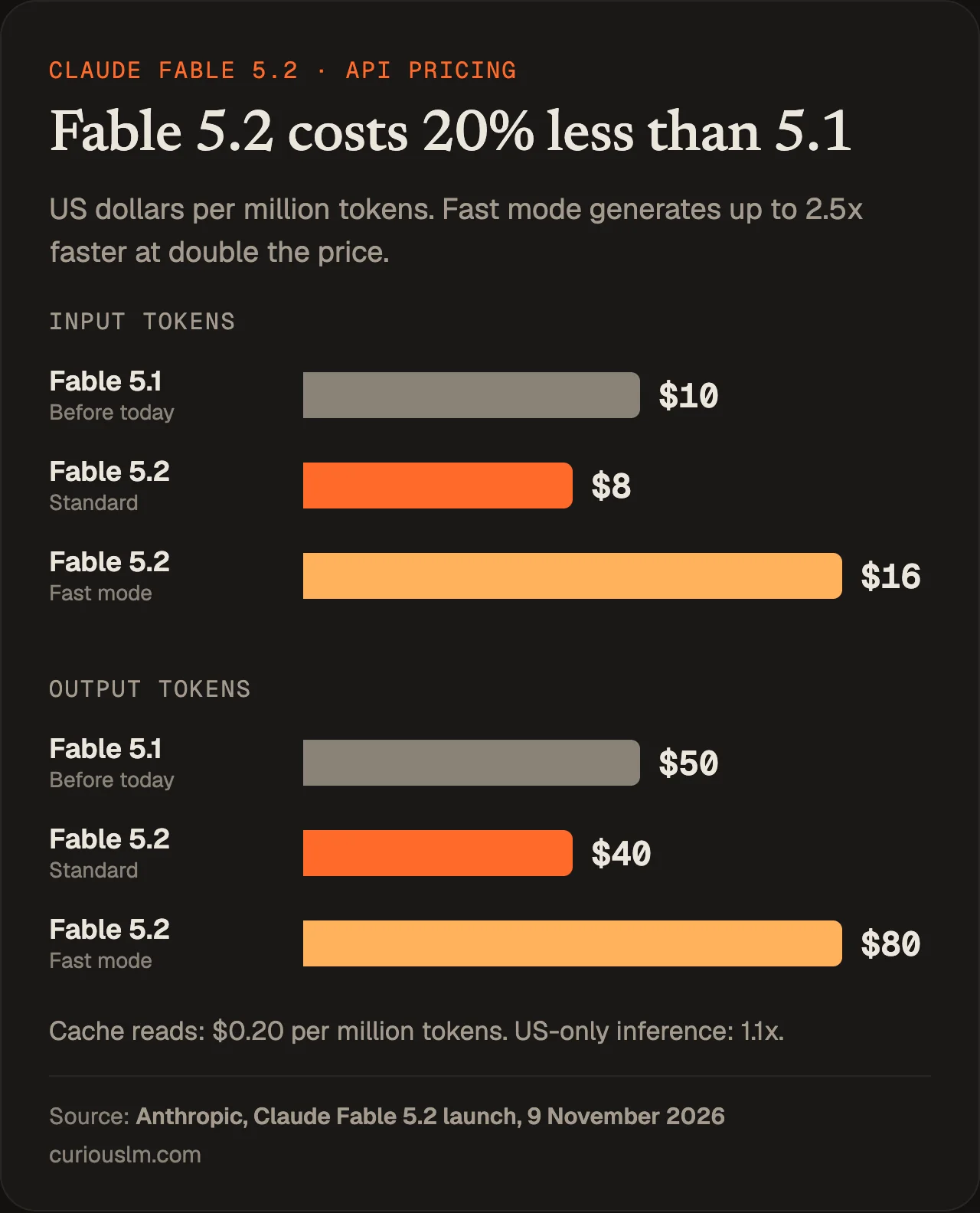 Chart: CuriousLM, from Anthropic's published prices.
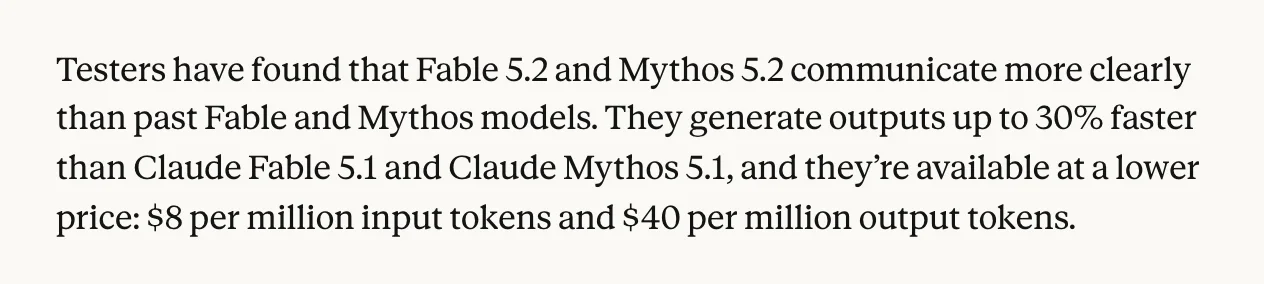 The price, in Anthropic's own words on the launch page. Screenshot: anthropic.com Cache reads cost $0.20 per million tokens, and inference pinned to US-only infrastructure carries a 1.1x multiplier.
A new fast mode costs $16 and $80 per million input and output tokens and generates tokens up to 2.5 times faster. It runs in Claude Code, on the Claude Platform, and on Google Cloud and Microsoft Foundry. Fortune frames the standard price as 20 percent below OpenAI's GPT-6 Astra, and cached reads as 80 percent cheaper than Astra's.
Anthropic also argues the model is cheaper per finished task, not just per token. On its FrontierCode 2.0 coding test, Fable 5.2 at High effort nearly matches Opus 5.5's best score for roughly half the cost per task, and on Humanity's Last Exam it matches Opus 5.5's top score at Low effort for under a tenth of the cost.
Benchmarks: ahead of Opus 5.5 almost everywhere
Anthropic describes Fable 5.2 as "a step above Opus 5.5 in almost all the capabilities we evaluated". Its published table shows FrontierSWE v2 at 69.9 percent against 62.3 for Opus 5.5 and 65.5 for GPT-6 Astra, Humanity's Last Exam with tools at 74.2 percent against 67.7 and 57.2, and the Remote Labor Index at 41.3 percent against roughly 21 for both rivals. The biggest jump is in robotics simulation, where RoboDojo Sim rises to 64.9 percent from 27.6 for Fable 5.1, though Anthropic ran that test internally.
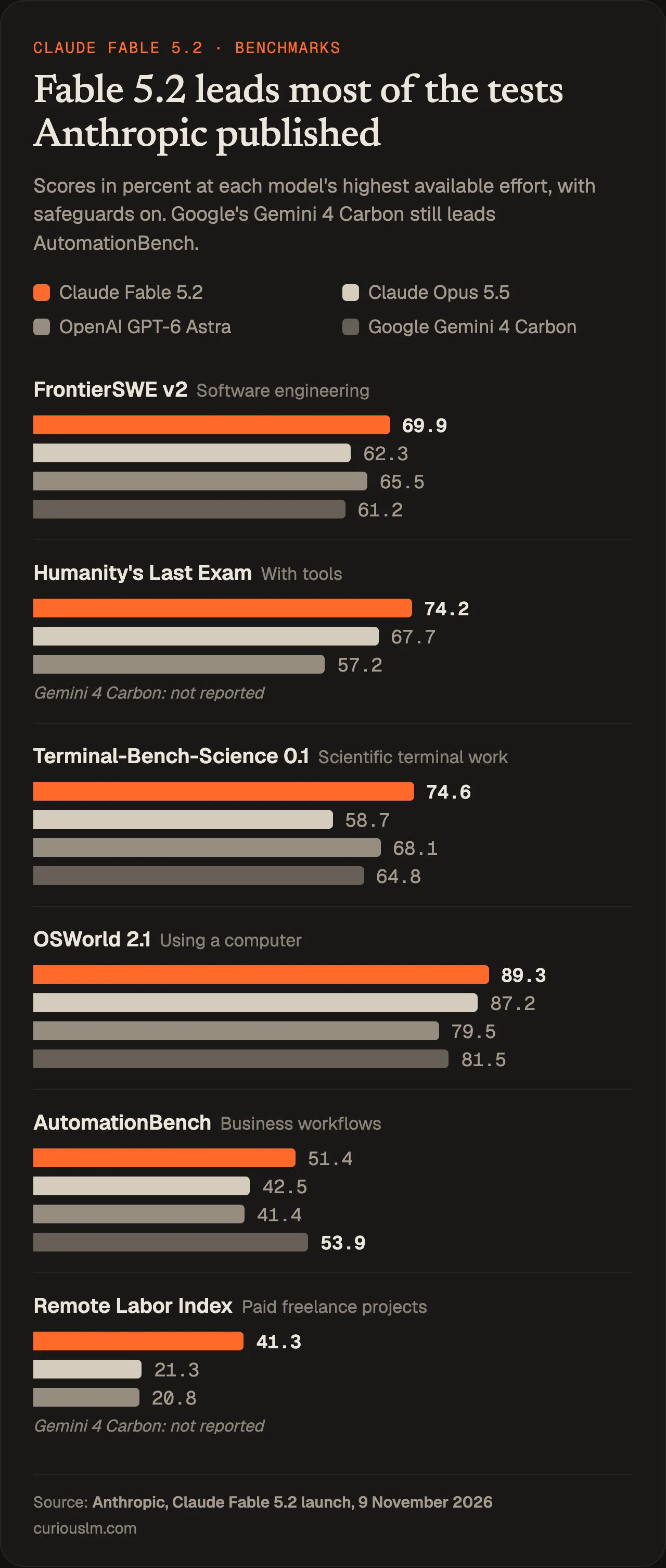 Chart: CuriousLM, from the scores Anthropic published.
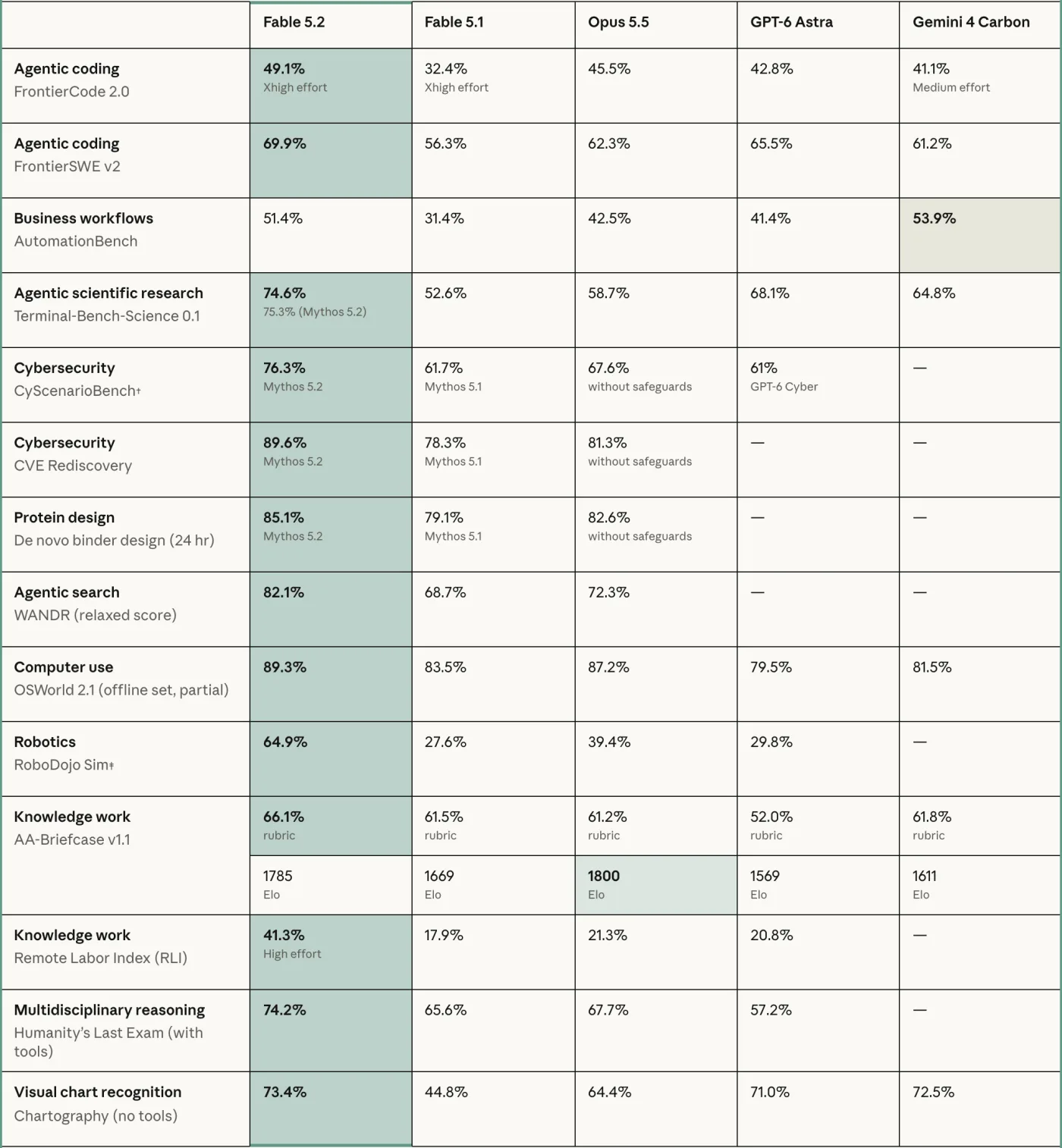 Anthropic's full benchmark table from the launch page. Screenshot: anthropic.com
The table is not a clean sweep. Google's Gemini 4 Carbon leads AutomationBench at 53.9 percent against Fable's 51.4, and Opus 5.5 keeps a narrow lead on the AA-Briefcase Elo rating. Anthropic says outputs arrive up to 30 percent faster than the 5.1 models, and that at the default Medium effort Fable 5.2 finishes hard tasks with fewer tokens.
Safeguards that block less, and where flagged work goes
Fable 5.2 still screens penetration testing, exploit generation, and most research biology. Flagged requests are answered by Opus 4.8 for cybersecurity and Opus 5 for biology, and API customers must configure a new Fallback API to handle that routing. The change is how often that happens: Anthropic reports about 55 percent fewer blocks than Fable 5.1, roughly 60 percent fewer in cybersecurity and 40 percent fewer in biology, with safeguards it calls as robust as before.
Anthropic also says this is its most distillation-resistant release, cutting the data harvestable through its outputs by 90 to 99 percent.
Who should use it, and the privacy trade-off
Anthropic's own advice is to start with Opus 5.5 as the everyday model and move up to Fable 5.2 for the hardest engineering, math, and research work. Its showcase examples fit that tier: a team of 1,000 Fable 5.2 agents formalized Fermat's Last Theorem in 30 hours, and the model designed three working electronic devices from scratch.
For anyone weighing privacy, one line on the product page matters: using Fable models requires 30-day data retention for safety monitoring by default. Zero data retention is possible only for eligible enterprise customers, through Enterprise Frontier Safeguards, which is in private beta. The most capable cloud models keep more of your data, not less, which is the gap on-device assistants exist to close.